Trumpet
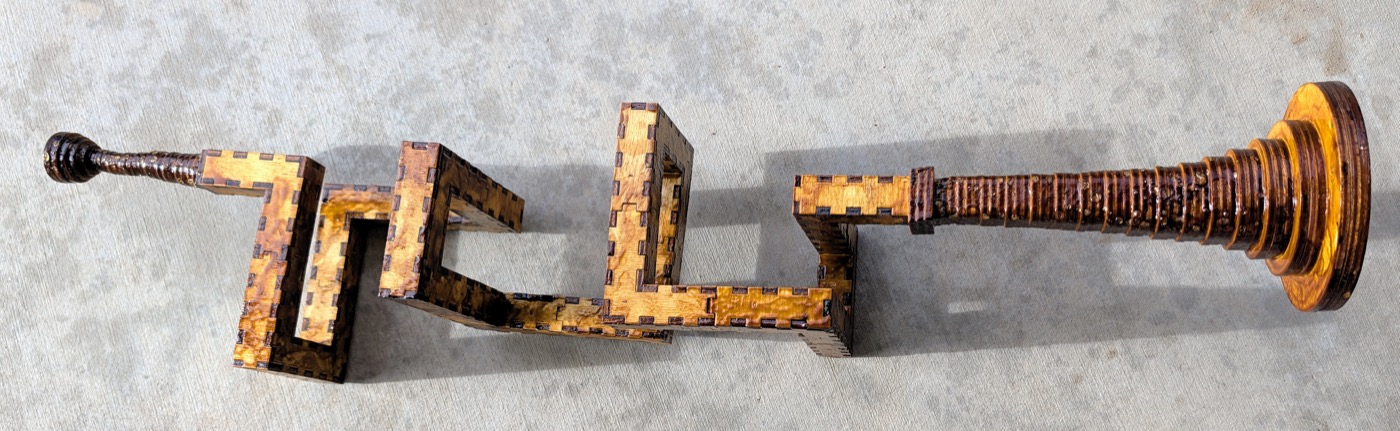
A trumpet cut flat from 3mm birch ply and glued into a tube. The airway is a 10mm square running through 16mm blocks — 10mm of air inside 3mm walls — and it never changes section from the mouthpiece to the throat of the bell.
The instrument that has been built is a coil of 1096mm in 12 sections, with a 72mm mouthpiece at one end and a 153mm bell at the other. It winds 1080° — three turns, right-handed, about a north–south axis. Everything else here is a candidate for the next one.
Both halves of that sentence were wrong until 2026-09-08. The mouthpiece on this instrument is 24 rings, not the 30 the design cuts: 72mm rather than 90, and it is the instrument that is short, not the drawing. And the coil winds three whole turns, not 2¾ — its walk is W U E D three times over, and its first and last blocks sit on the same cross-section point, which a fractional number of turns cannot do.
The idea
A brass instrument is a long tube you have to fit into a small space. A trumpet does it with three tight bends and a lot of drawn brass. This does it by treating the tube as a walk through a lattice of cubes — north three, up two, east three — and cutting each run of that walk as a flat-packed box.
The walk is written down. N N1 W3 U2 E3 N3 D3 W2 U3 N3 E3 D2 W3 N3 U3 E2 D3 N1 is the bore of the built instrument: the first letter is the direction you enter from, and every term after it moves that many blocks. A generator turns that string into cut files, checks them, and tells you what you are holding.
python3 tools/bore_split.py "N N1 W3 U2 E3 N3 D3 W2 U3 N3 E3 D2 W3 N3 U3 E2 D3 N1" \
    --bore=10 --straight=30 --no-write
A bare letter costs no block. The turn happens inside the block you arrived at, so the tube is 1 + the sum of the numbers blocks long. Forty-three steps, forty-four blocks.
What decides a good bore
Three things, and they pull against each other.
Length, because length is pitch. A tube twice as long sounds an octave lower. The four coils in parts/bore/concept/walk/no-elbows/coil/fold2-long-straight/ are one shape cut at four lengths — 274, 548, 822 and 1096mm, an exact 1:2:3:4 — and the built instrument is the longest of them.
Their folder names say 0.75, 1.5, 2.25 and 3 turns, and measurement agrees: the four sweep 270°, 540°, 810° and 1080° about the coil axis, one group of three lateral legs being three-quarters of a turn. Both the lengths and the turn counts are exact. This note said the opposite between 2026-09-06 and 2026-09-08, and the folders were renamed down a quarter turn on the strength of it;
spiral_metrics.jsstill reports the figure that caused it.
Section, because section is tone. The airway must stay 10mm square the whole way. That is what makes a turn expensive: a block that turns has openings on two different faces and both must sit square, so a turning block has to stay cubic even when the straights are stretched. The built bore is 28 straight blocks at 30mm and 16 turns at 16mm, which is where its 1096mm comes from.
Elbows, because an elbow is a bad part. An elbow is a turn stranded as its own one-block piece: three tabs, fiddly to hold, weak at the seam. Every walk offered here is elbow-free, and --refuse-elbows stops the generator before it writes anything rather than handing you a folder to inspect.
Fewest elbows is not cheapest in parts. Measured over 133 walks it trades 23 elbows for 46 more pieces, because folding a turn into a bend adds two walls to that bend while a lone elbow is only four parts for its whole block. It is still the right trade: parts are cheap and bad seams are not.
The instrument, end to end
| length | what it is | |
|---|---|---|
| mouthpiece | 90mm | 30 rings, 10mm square → ø3.66 throat → ø17 lip |
| bore | 1096mm | 44 blocks, 12 sections, no elbows |
| bell | 153mm | 17 rings, 10mm square → ø86 rim (ø80 of air) |
| total | 1339mm |
For scale, a B♭ trumpet is about 1480mm of tube, so this is a little shorter and should sit a little higher.
It plays. One of its notes is F4 — 349.2 Hz, measured off the built instrument.
Do not size a bore from a pipe formula. F4 lands on no simple mode of a 1.339m tube: it is 2.73 times the open-open fundamental (c/2L = 128 Hz) and 5.45 times the closed-open one (c/4L = 64 Hz), and neither multiple is a whole number. That is what a bell and a mouthpiece do — they pull the resonances away from where a plain tube would put them, and how far is not something either formula knows. Length still sets the register, which is why the four truncations above are worth cutting: their bores are an exact 1:2:3:4, so what the ends actually contribute is measurable rather than assumed.
The mouthpiece and the bell are shared
Neither end is touched by the way a bore turns, so only the tube belongs to an instrument. Both live in parts/, both take --bore, and both close onto the same 10mm square in a 16mm face.
cd parts/mouthpiece && python3 mouthpiece-round.py
cd parts/bell && python3 bell-round.py 17 --bore=10 --length=152 --mouth=80
Each rebuilds its shipped sheet byte for byte and writes it into its own cut-files/.
The joint at each end is a square annulus of ply 3mm wide — 10mm inside, 16mm out. The bell's ring 0 is a flange that covers all of it: a 22mm square with a 10mm hole, standing 3mm proud. This was wrong until 2026-08-26, when the throat was taken from the bore's outside rather than its channel and ring 0 sat entirely outside the face it was supposed to seal. It was reported as gaps at the joint, which is exactly what it was.
A page for each
Each of these carries the walk it is cut from, its blocks and centreline, its sections with their plates and sheet sizes, and a link to a viewer you can turn at tab size. The first is the instrument that exists; the next three are candidates that have not been cut.
| the three-turn trumpet | 44 blocks, 1096mm, twelve sections — the one that was built, and it plays |
| the coiled trumpet | 59 blocks, 944mm, eight sections — coils flat and drops twice |
| the switchback trumpet | 22 blocks, 352mm, six sections — folds back on itself twice |
| the greek spiral | 68 blocks, 1088mm, one section — a flat meander, the only bore here that cuts in one piece |
| the bell and the mouthpiece | The two ends, shared by every bore on the 10mm channel |
Cutting
Everything is 3mm birch ply on an xTool P2S, 600 × 308mm of bed.
Colour is the cut order: blue engraves, then green → orange → cyan → black, and black frees the part. On a bore section blue engraves the section number and black cuts. On a ring, orange takes the aperture first so the hole is in before the outline releases the part.
Every part is engraved with its section number, and two sections of the same shape are cut separately so each carries its own. The built bore has two such pairs — 3 and 6, and 7 and 10.
Sections are numbered from the mouthpiece. Assemble in order; the first piece is marked buttin and the last buttout, and those two are the only plain ends.
What is in here
parts/
  mouthpiece/       the shared mouthpiece, and its viewers
  bell/             the shared bell, square and square-to-round
  bore/
    built/          the bore that exists as an object
    concept/        every candidate, none of them cut
tools/              the generator, the gate, and the walks
three-turn/         a page each: the instrument that exists, the three
coiled/             candidates worth reading about on their own, and the
switchback/         two ends they all share
greek-spiral/
ends/
The four page directories hold nothing but a README.md and the index.html rendered from it. Every number on them is read back out of the walk, the cut file or the generator, never typed from memory.
built/ is one design. Nothing in concept/ has been cut, and a folder there is not a promise that it should be.
A walk is filed under three facts about it, each of which costs something at the machine:
concept/walk/<elbows|no-elbows>/<family>/<contact|no-contact>/<design>Family is the shape — coil, meander, spiral, hilbert — and it is measured, not asserted: a coil has an axis it advances along and a handedness, a meander has neither.
Elbows is whether any turn is stranded as its own one-block piece.
Contact is whether the bore comes back and touches itself: two blocks sharing a face, an edge or a vertex without being joined along the tube. At a face the airway runs past 6mm of wood rather than 3; at an edge or a vertex the two walls meet on a line or a point, which is a place for the glue-up to go out of true. None of it is fatal, and a tight coil can rarely avoid it — but it is a property of the walk, decided before anything is cut, so the library sorts on it.
Blocks two apart along the walk are edge-neighbours at every single turn — that is the geometry of turning, not the bore touching itself, and counting it would file every walk here under
contact. So contact is measured between blocks three or more apart. Of the 20 designs filed this way, 11 are both elbow-free and touch-free, 7 touch, and 2 are touch-free but carry an elbow.coil/search/is not among them: it is the search that the promoted coils came out of, and its ten remaining walks split 4 to 6 across the line.
Three ways to make a tube
They are not variations on each other. The section grows at every turn, and how much is the whole comparison:
| curve | section at a turn | why it exists | |
|---|---|---|---|
| lattice walk | 90° turns | +41.4% | fits a walk into a box |
| swept curve | any planar curve | +3.5% at 30° | constant section on a smooth curve |
The lattice walk is what the built instrument uses, and it is the more expensive per turn by a wide margin. It buys packing: a walk folds into a box a smooth curve does not reach.
A third construction, a closed ring of facets, is not listed: a loop has no ends, so it cannot take a mouthpiece or a bell. ribbon_bore.py --shape=torus still draws one, because the mitring it needs is the same mitring every other shape needs, but nothing here is a candidate bore.
The swept curve (parts/bore/concept/swept-curve/) sweeps a rectangle along a planar curve, so two faces are flat and two are faceted. Seven designs are drawn: a serpentine and an opposed pair at 1000mm, three spirals at 1000, 1458 and 1767mm, a wave at 836mm and a double spiral at 1506mm — plus a 30° coupon that exists to prove the tooth survives the bend.
One of the seven is in ply. The 1000mm spiral — R35to113, 19 segments of 45°, its radius growing 34.7 → 112.9mm — has had its cheek sheet cut, and cut twice, because the two cheeks are the same part and both go on the same way up.
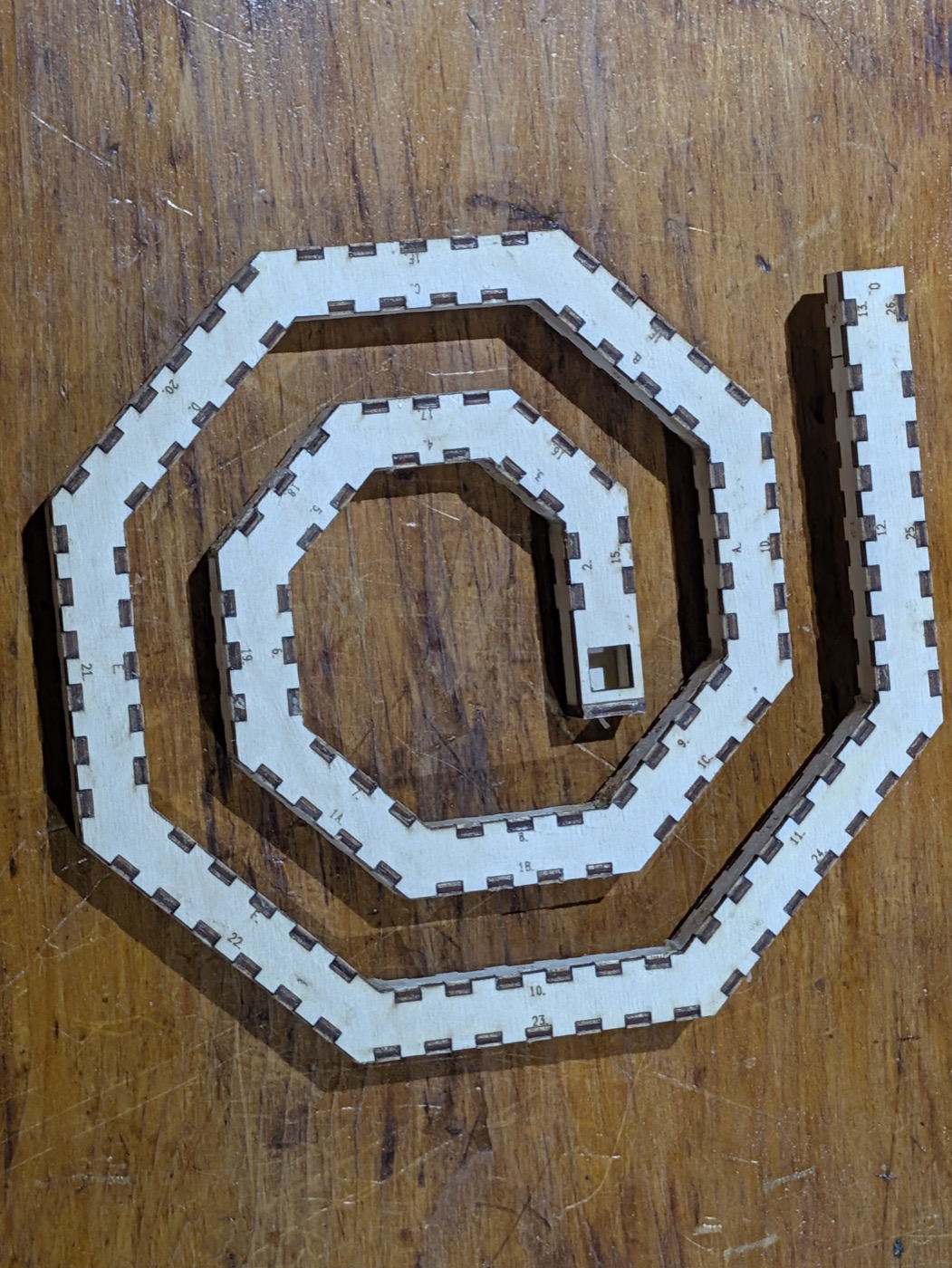
The band is a single closed outline of 40 vertices, 216.50 × 218.51mm on a 236.50 × 238.51mm sheet, and it carries 149 mortices for 38 wall panels. Every one of those mortices is open at the rim, which is what --narrow buys: the cheek is no wider than the duct, so each tab is held across its thickness on one side only. The square hole near the inner end is the port — a 10mm square, drawn 9.85mm because the 0.15mm kerf opens it the rest of the way, and square rather than round because --port-square asks for the bore's own section. The wall panels that stand in the mortices are a second sheet, 574.95 × 96.60mm, and are not in the photograph.
The double spiral is the one shape here whose two arms interleave. Two of them half a turn apart about one centre, crossed in the middle by a straight: 1506.4mm of bore on a cheek plate 237 × 244mm. Arm B is arm A turned through 180°, so the gap between neighbouring passes is half the radial pitch by construction rather than by search — choose the pitch and you have chosen the gap. The cheek is a 20mm band, so 46mm a turn is the first pitch that clears it, and the two passes come out 23.00mm apart.
Its centreline is the one that does not step its arc radius facet by facet. Vertices sit on a smooth spiral r = R0 + b·θ sampled every facet instead, which the note beside --shape=spiral warns is the construction offset() cannot follow. That note is about offsetting a smooth curve and faceting the result separately; offsetting the faceted centreline is exact whatever placed its vertices, and the airway measures 4.4e-14mm from the bore here. The stepping construction could not be used anyway — its polar radius advances 7mm across one half turn and 32mm across another, and two arms interleaved at those radii collide.
The open middle is forced, not styled. A straight through the centre is tangent to the crossover arc only when the arm's inner end lies outside twice that arc's radius, so R62 against R30 is a floor; tighten it and the inner panels stop being long enough to hold a 6mm tooth, and the generator refuses rather than drawing one. Both openings still come out on the rim facing opposite ways, which is what a total turning of 0° buys.
Two arms wound into each other is the one arrangement here that could have run the bore back into itself, and the check that would have caught it already existed: the cheek outline does not cross itself. It passes, at 85 edges and no crossings.
The coil search
parts/bore/concept/walk/no-elbows/coil/ holds seven coils promoted out of a search of seventeen, each because it won a category outright or tied for one. Each carries a why.txt with its walk, its win, and twelve metrics recomputed from that walk:
| coil | wins |
|---|---|
3x3-51 | smallest box, 459 |
2x2-134 | fewest distinct shapes, 2 |
3x7-22 | tightest spiral, 34mm rise per turn |
5x5-50 | least tube per turn, 15.1 blocks |
4x4-50 | calmest bore, 20.40 turns/m (tied) |
5x8-18 | largest average plate, 3009mm²; and two ties |
3x3-54 | fewest pieces, 30 (tied); smallest box with no shared wall (tied) |
Ten of the seventeen remain in search/, and a coil listed above as tied is tied with one of them. The scoring is in search/SCORING.md.
The toolchain
tools/ ships no cut files of its own — only the thing that makes them.
bore_split.py | the generator: a walk in, per-piece cut files out |
check.py | the gate, run automatically by every --write |
regress.py | runs the gate over the whole library |
snakeboxvar.py | the Boxes.py generator that draws a section |
svgpath.py | reads back what was written — the gate parses the file, not the plan |
assemble.py | builds a section as a solid and asks directly whether it is sealed, rather than testing a proxy |
viewer.py | the one page builder; every viewer page here comes from it |
bore_render.py | stills, coloured by piece or by direction of travel |
nest.py | lays parts out on a sheet |
hilbert.py | writes a Hilbert cube as a walk |
mcwalk.py | renders a walk that crosses itself, which the generator refuses |
sizes.py | one design at more than one block pitch, in one viewer |
The gate
Nothing here is cut on trust. bore_split.py --write runs the checks itself and refuses to leave a folder unchecked; tools/regress.py runs the whole library.
cd tools && ~/Software/boxes/venv/bin/python regress.py27 designs, 0 failed, 7767 individual checks.
It checks that each section closes round its bore, that the assembled bore is one sealed passage, that its volume matches the walk, that no feature is under 1.5mm, that every sheet fits the bed, that every seam is one tab side and one slot side, and that no engraving lands in a slot or off the material.
Use the virtualenv python. check.py imports shapely, which the system python3 does not have — and bore_split.py writes every file before it gates them, so a system-python --write leaves a folder of finished-looking cut files and a traceback where the gate should be.
A passing gate means no check failed, not that the part is buildable. Two real fit problems have reached the bench past a clean gate. The gate's floor is 1.5mm and nothing compares a feature against the features beside it.
Clearance
PLAY_BY_BORE is a lookup of what has actually been cut, not a curve through it, and it has one row: 0.025mm per side at the 10mm bore. A bore that is not in the table gets that value too — too loose is a worse joint than too tight is no joint — and says on stderr that it is guessing, because a guess that looks like a measurement is the dangerous kind.
Whether the requirement is absolute, a fraction of the tab, or something else takes a second bore to say, and there is one bore. tools/coupon-16mm/ is the coupon that would settle it.
Building it
- Cut the twelve bore sections from
parts/bore/built/coil/fold2-long-straight-3t/cut-files/, in order. - Cut the bell — 17 rings, three passes, 51 pieces. Cut once and you get a 51mm stub instead of a 153mm bell.
- Cut the mouthpiece — 30 rings, one pass.
- Glue each bore section closed, then join them in engraved order.
- Stack the bell rings from ring 0 at the bore; stack the mouthpiece rings from ring 0 likewise. Both are engraved in hex,
0at the bore. - Sand and fill the mouthpiece's staircase and round its rim over before you put a lip to it.
The bell is cut more than once. Each sheet draws every ring once, and the x3 in its filename is how many times the sheet goes through the machine.
More, and licence
Built for LaserMadeMusic, where the cutting and the playing are shown.
The rest of the build files — every instrument, each with its own writeup.
Download everything as a ZIP — the generators, the gate, every cut file and every candidate bore.
Released under CC0 1.0. Do what you like with it. parts/LICENSE and tools/LICENSE are copies of the same text, so a directory taken on its own still carries it.