Win(d)Bag
A Great Highland bagpipe tune player, begun in BASIC on an IBM PCjr and rewritten for Windows 3.1 in Visual Basic 3 between 1995 and 2000. Tunes are typed as plain text, one bar per line, and played on the PC speaker with the melody and gracenote speeds set separately. It now runs in a browser.
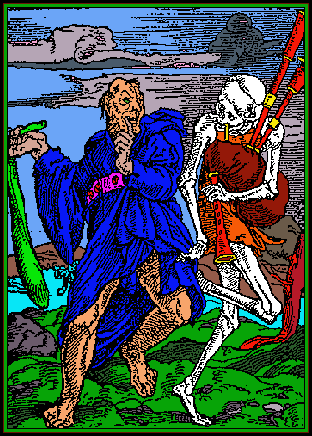
Whose work this is. Win(d)Bag, its .wbg
tune format, the practice-chanter tuning window and the Perl players are Michael
Carnright's. The web edition (play.html) and the Python players are later
ports of the same program. The colouring of the Holbein woodcut is his. The tunes
are traditional or his own, and their .wbg transcriptions are his.
What it did
A piper learning a tune wants to hear it slowly, but bagpipe gracenotes are played as fast as the fingers allow whatever the tempo. Win(d)Bag kept the two apart: one scroll bar for the melody's pace, another for the gracenotes, and both could be moved while the tune played. The time a gracenote takes is taken from the melody note that follows it, so very slow gracenotes eat into the melody, which the original README warns about. A four-count of high-G gracenotes sets the tempo before the tune starts, and the tune can be paused, resumed or stopped.
 Play
 Pause
 Resume
 Stop
 Chanter
 About
The button images from version 0.2, from the VB3 source.
Versions
| Version | What changed |
|---|---|
| The first Win(d)Bag | Written in BASIC on an IBM PCjr. It is lost; no copy survives. |
| 0.2, 20 December 1995 | Changes since the first version: the separate practice-chanter program merged into the player; word buttons replaced by images; the tune list split into one index per book the tunes were transcribed from, so a new book could be added on its own. |
| 0.2, 16 September 2000 | A later build of the same version, and the source in this repository. |
| Perl players | windbag.perl plays the same files through Audio::Beep; windbag2.perl adds named embellishments, so dbc can be written for a doubling on C instead of its three gracenotes. |
| Python players | A terminal player, a Tk window and a uilleann-pipe variant, for macOS. |
| Web edition | Web Audio in one HTML file, with a square wave to sound like the PC speaker, the tunes built in and any .wbg file droppable on it. |
The .wbg format
A tune is a list of note, length pairs separated by commas or line breaks; spaces are ignored, so a tune can be laid out one bar per line. A length of 0 is a gracenote.
G,0,a,48,g,0,d,0,g,0,c,0,d,96
is a high-G gracenote on a low-A crotchet, then the four gracenotes of a doubling on D, then D as a minim. The original format notes give the reason for the odd-looking lengths: a whole note is 192, which is 3 × 64, so triplets come out as whole numbers too.
| Length | Note |
|---|---|
| 0 | gracenote |
| 3 | 64th |
| 6 | 32nd |
| 12 | 16th |
| 24 | 8th |
| 48 | quarter |
| 96 | half |
| 192 | whole |
| Length | Note |
|---|---|
| 9, 18, 36, 72, 144 | dotted 32nd to dotted half |
| 8 | 16th triplet |
| 16 | 8th triplet |
| 32 | quarter triplet |
| 64 | half triplet |
The nine notes of the chanter are g a b c d e f G A: low G up to
high A, with capitals for the two high notes.
Embellishment names
The later players accept names for the common embellishments, which are expanded into gracenotes before the tune is read:
| Name | Gracenotes | Embellishment |
|---|---|---|
gg tg | G · A | high-G, high-A ("top") gracenote |
bg cg dg eg fg | B · C · D · E · F | single gracenotes |
strlg strla | g · a | strike on low G, low A |
dbb dbc dbe dbf | G b d · G c d · G e f · G f G | doublings |
dbhg dbha hdbf | G f · A G · f G | doublings on high G and high A, half doubling on F |
grp | g d g | grip |
tar | g d g e | taorluath |
hvthrd | g d g c | heavy throw on D |
gstrd | G d g | G strike on D |
brl abr | g a g · a g a g | birls |
Tuning a practice chanter
Practice chanters are not all at the same pitch, so version 0.2's chanter
window lets you match the computer to yours. Set low G by ear, and every note
above it follows by fixed ratios between neighbours; then nudge each note in
turn going up. The result is saved to CHANTER.TXT.
| Step | G→A | A→B | B→C | C→D | D→E | E→F | F→G | G→A |
|---|---|---|---|---|---|---|---|---|
| Ratio | 9/8 | 9/8 | 10/9 | 27/25 | 10/9 | 10/9 | 27/25 | 10/9 |
| Hz | 412→464 | 522 | 580 | 626 | 696 | 773 | 835 | 928 |
The ratios from low A to high A multiply to exactly 2, an octave, and the
frequencies in the CHANTER.TXT that ships with the source are
this chain from a low G of 412 Hz, rounded to whole hertz at each step.
The tunes
The web edition has 34 tunes built in:
- Marches and airs: Brian Boru's March, The Blue Bells of Scotland, The Minstrel Boy, The Red Fox, Robin Adair, The Rowan Tree, The Star of the County Down, Will Ye No Come Back Again, The 79th's Farewell to Gibraltar, The Marquis of Huntly
- Irish: Fanny Power (O'Carolan), Thady You Gander, The Eagle's Whistle, The Exile, Paddy and its four parts, and three more numbered Irish tunes
- Band sets: Garry Owen, an Irish set, Miss Kirkwood and The Children, Retreats, Scotland the Brave, The Bonny Lass of Fyvie
- Exercises: two short practice exercises, numbers 49 and 50
- Others: The Duke of Atholl's Salute (piobaireachd), the Epitaph of Seikilos (the oldest surviving complete piece of music, set for the chanter)
- Demos: a chanter scale, and a sampler of the embellishment names above
The tune files are in tunes/. To add one, put a .wbg
in tunes/ and run python3 bundle_tunes.py, which rebuilds
the list built into play.html. Or just drop the file on the page.
In this repository
play.html | the web edition; play.html?test runs its parser tests |
vb3/ | the Visual Basic 3 source of version 0.2: forms, modules, project file, button images, the format notes and the original READMEs |
perl/ | the Perl players and their chanter and four-count files |
python/ | the Python players (they read the comma format, without embellishment names) |
tunes/, bundle_tunes.py | the tunes, and the script that builds them into the page |
The Visual Basic runtime and the custom controls the program needs
(VBRUN300.DLL, CMDIALOG.VBX, THREED.VBX,
WINSOUND.DLL) are not included; they were never the author's to share.