The switchback trumpet
A trumpet bore that folds back on itself twice. 22 blocks, 352mm of centreline, six sections, every turn a bend and nothing touching — among the shortest lattice walks here, and the one to cut first if you want to find out whether the joints go together before you commit a metre of ply to it.
Turn it → The viewer is a page of its own, not a frame in this one: drag to rotate, and the slider reveals the bore a block at a time in the order you would assemble it.
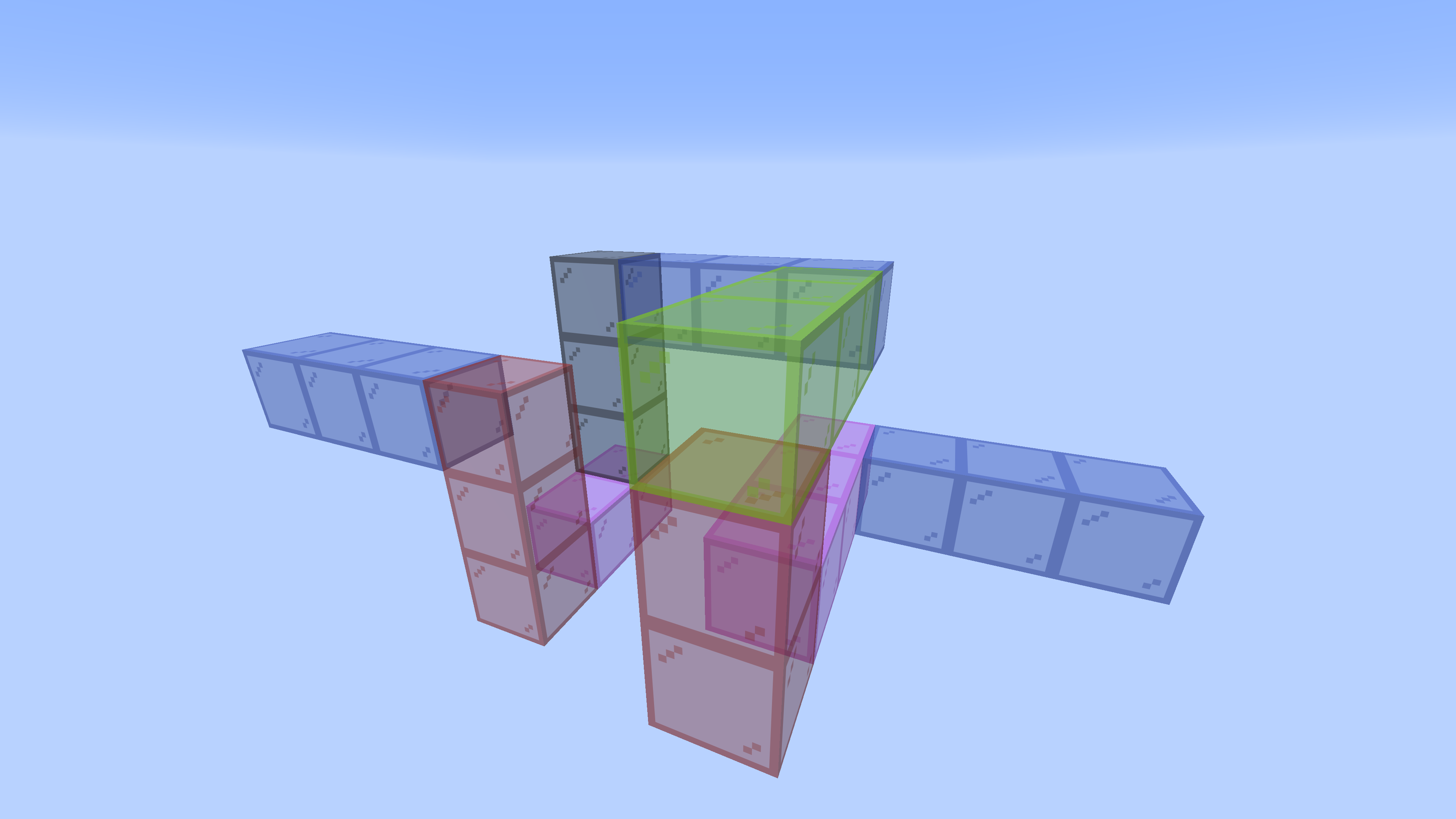
Screenshot from Minecraft. Minecraft is a trademark of Mojang Studios; this project is not affiliated with Mojang or Microsoft.
The walk is the whole design
N1 W3 U2 E3 N3 D3 W2 U3 N1The first term is the way you face at the mouth and how far you go before anything turns; every term after it turns where you stand and then travels that many blocks. So the bore is 1 + the sum of the numbers — 21 + 1 = 22. Axes are Minecraft's: U/D are +Y/−Y, N is −Z, S is +Z, E is +X, W is −X.
The walk is kept in ../tools/walks/coil_fold2.txt, and regress.py beside it names this folder as where its cut files land. The viewer page carries the same string, and the generator will read either, but they are only equal because the page was generated from the file. Read it out of the file.
No lead-out to write, and why that costs nothing
A walk used to be allowed to end with a bare letter naming the way you leave. This one never did, and the notation no longer has one: you leave facing the last term. Nothing is lost. A bare letter carrying your own heading only restated it, and the six SVGs come out byte-identical written either way. What it could also do was name a different heading — N1 U turned the final block and stranded the final turn as a piece of its own — and that is the half of it worth losing: the last block cannot be stranded any more, because there is no longer a way to ask for one.
The numbers
| blocks | 22 |
| centreline | 352mm |
| sections | 6 |
| parts | 40, over 6 sheets |
| bounding box | 64 × 64 × 96mm — 4 × 4 × 6 blocks |
| airway | 10mm square, constant |
| block pitch | 16mm — 10mm of air in 3mm walls |
| elbows | none; every turn is a bend |
| contact | none |
| legs | north 6, west 5, up 5, east 3, down 3 |
A block is 16mm, not 10. The bore is the air; the block is the air plus two walls. The two numbers are 6mm apart, and a folder named for one and gated at the other cuts a tube nobody asked for. A run of N blocks is 16N mm, which is where 352 comes from.
The six sections
Numbered from the mouthpiece; assemble in order. A section is one flat snake, so it is one SVG, and every part is engraved with its section number because the sections only go together one way.
| # | blocks | in → out | plate | shape | parts | sheet |
|---|---|---|---|---|---|---|
| 1 | 1–3 | N → W | 2×2 | BDL~a |
6 | 241 × 56mm |
| 2 | 4–8 | W → E | 2×3 | BLUUR |
8 | 343 × 72mm |
| 3 | 9–11 | E → N | 2×2 | BRD |
6 | 253 × 56mm |
| 4 | 12–14 | N → D | 2×2 | BDL |
6 | 247 × 59mm |
| 5 | 15–19 | D → U | 3×2 | BDLLU |
8 | 369 × 59mm |
| 6 | 20–22 | U → N | 2×2 | BRD~b |
6 | 253 × 56mm |
~a and ~b are the plain ends — the only two faces that do not couple to another section, and the ones the mouthpiece and the bell land on. The filenames say buttin and buttout.
Sections 2 and 5 are the folds: five blocks each, carrying a hairpin internally rather than stranding its turn as a separate piece. Sections 3 and 6 are both BRD and share a 253 × 56mm footprint, but they are not the same cut: section 6 ends plain at ~b, so that face carries no fingers. All six sheets are distinct.
The cut files
In ../parts/bore/concept/walk/coil/fold2/bore/cut-files/:
bore10-coil-fold2-01of06-bend-DL-buttin-cut-files.svg
bore10-coil-fold2-02of06-bend-LUUR-cut-files.svg
bore10-coil-fold2-03of06-bend-RD-cut-files.svg
bore10-coil-fold2-04of06-bend-DL-cut-files.svg
bore10-coil-fold2-05of06-bend-DLLU-cut-files.svg
bore10-coil-fold2-06of06-bend-RD-buttout-cut-files.svg
Every file is millimetre-true at 1 user unit = 1mm. Blue engraves, then black cuts — blue writes the section number on every part, black frees it.
Rebuild it
The generator lives in tools/ at the repository root, and both commands run from there. Report only, writing nothing:
python3 tools/bore_split.py "N1 W3 U2 E3 N3 D3 W2 U3 N1" --bore=10 --no-write --refuse-elbows--bore=10 is the airway; the 16mm block follows from it at 3mm ply. The generator cuts an elbow by default in this copy; --refuse-elbows makes it refuse one instead, so the bend-only claim is a gate rather than a reading. Writing rewrites every sheet in the folder, so it runs under the venv python that has the gate's dependencies:
cd tools && ~/Software/boxes/venv/bin/python bore_split.py \
    ../parts/bore/concept/walk/coil/fold2/bore/bore.html \
    --write ../parts/bore/concept/walk/coil/fold2/bore --refuse-elbows
Stretched, the same walk is longer
Leave the walk alone and lengthen only the blocks that run straight, and the tube grows without the shape changing. --straight=30 turns this 352mm into 548mm on the same six turns. The built instrument is that idea taken three turns further — see the trumpet writeup.
The two ends
Only the tube belongs to an instrument. Neither the mouthpiece nor the bell is touched by the way a bore turns, and every bore here is on the same 10mm channel, so one of each serves all of them — the bell and the mouthpiece.
More, and licence
The three-turn trumpet — the bore that plays, press-fit and blown, rather than a candidate.
The trumpet writeup — the idea, the notation, the gate, and the whole library.
The rest of the build files — every instrument, each with its own writeup.
Released under CC0 1.0.