Bagpipe chanter
A full Great Highland bagpipe chanter in 3mm plywood. Its conical bore is a tapering square of four long strips, a hexagon of six or an octagon of eight, finger-jointed and glued, from the sole up into a collar of stacked plates. The tenon above the collar holds the reed's seat and goes into the chanter stock. It is the standard strip chanter taken to a full chanter: four long strips round a square bore, with a real chanter's holes.
The real chanter is Jeremy Starcher's Dis-Enchanter (2017), a 3D-printed chanter that its designer copied from a 1970s Hardie. Its bore, holes, collar and sole are measured from its STL, and this chanter keeps every hole where the Dis-Enchanter's is.
Output is millimetre-true — 1 user unit = 1mm with a physical width/height — so it prints and cuts at real size.
It has not been cut or played yet. The Dis-Enchanter is a model to follow, not a proven scale: its designer calls it mostly working, with F and G low on the first print. The holes here are sized by an acoustic model that cannot reproduce a real chanter's scale, used only for the difference between this chanter and the Dis-Enchanter. Before you cut says what that costs.
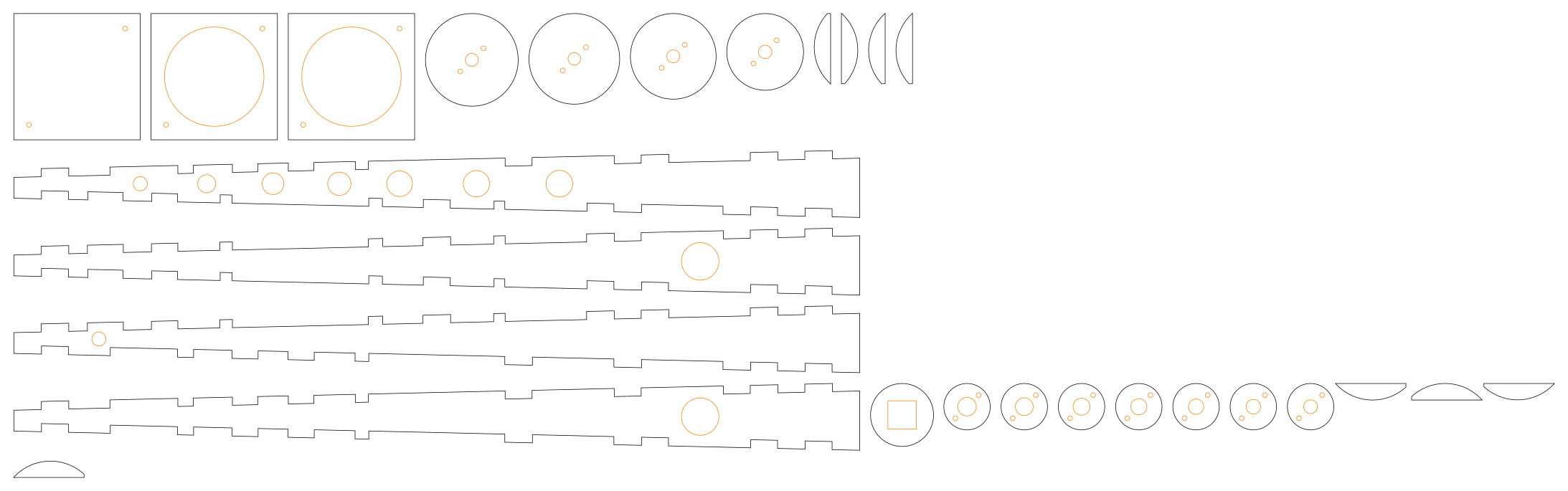 |
| Four sides: the whole chanter on one 578 × 181mm sheet. |
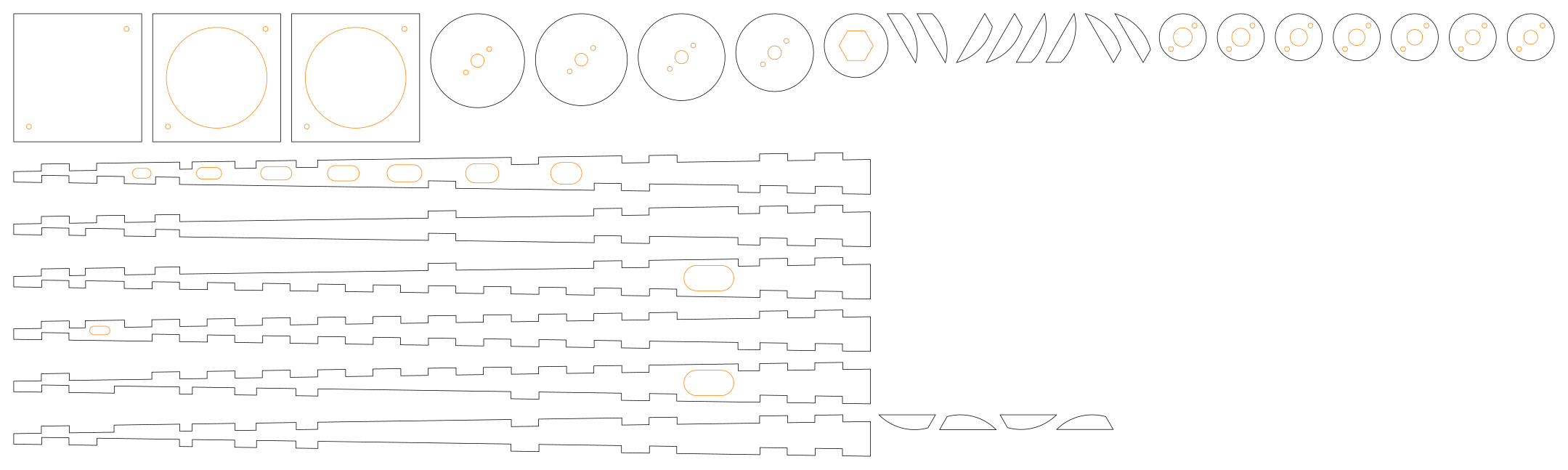 |
| Six sides: the whole chanter on one 571 × 171mm sheet. |
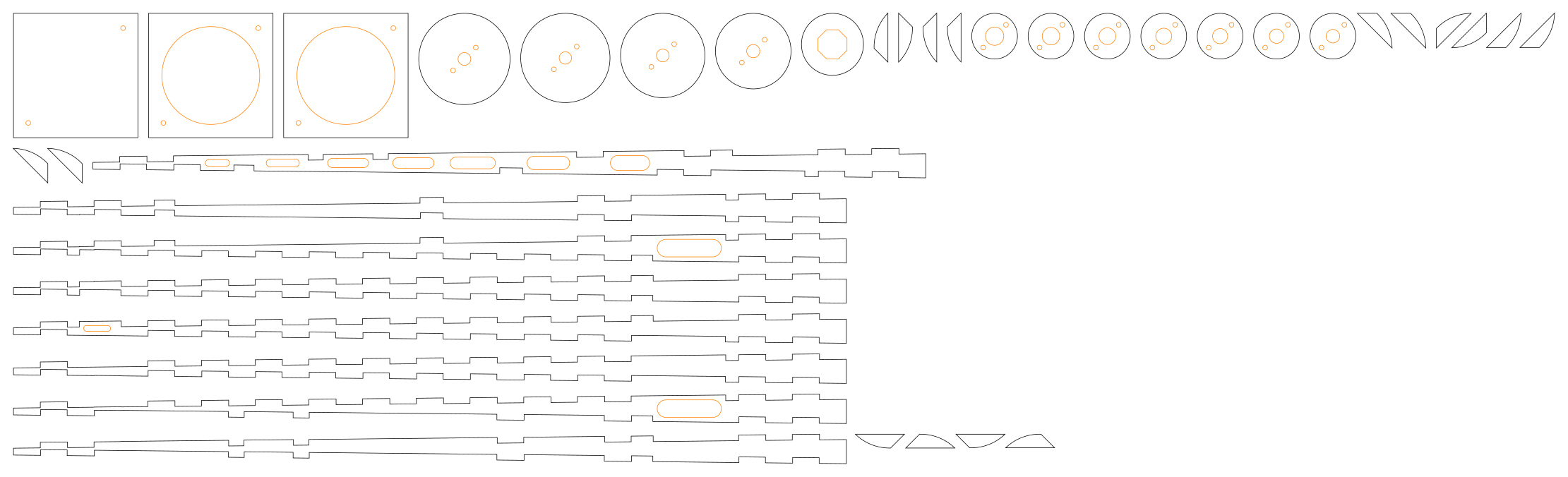 |
| Eight sides: the whole chanter on one 588 × 179mm sheet. |
The chanter
| Bore | the Dis-Enchanter's cone made square, the same area at every height: 4.57mm square where the strips meet the collar, 18.76mm at the sole, against its 5.16 to 21.17mm round. Each face leans 1.3° |
| Strips | 312mm long, tapering, finger-jointed, glued. Round each hole its strip owns both corners, so the hole has ply all round |
| Holes | where the Dis-Enchanter's are: seven in the front strip, high A in the back, and a side hole in each side strip near the sole |
| Foot | two layers of four flat strips round the strips' bottom, cut to the Dis-Enchanter's 36.5mm sole: 6mm tall, its sole 7.25mm |
| Collar | the Dis-Enchanter's bead, plate by plate: 34.1, 33.3, 31.5 and 28.2mm round plates with its 4.8 to 5.1mm throat, then a 23.1mm plate the strips' top stands in |
| Tenon | 7 round plates 17mm across, with the reed's seat tapering 7.0 to 5.2mm through them, the Dis-Enchanter's taper. Hemp it into the stock |
| Joints | the strips, foot and collar's socket plate glued; the collar's round plates and the tenon press-fit on two 2mm pins; the seams sealed with shellac |
| Jig | a 46.5mm square base and two rings with a 36.8mm hole, pinned into a cup, to glue the foot up in; not part of the chanter |
| Sheet | one 578 × 181mm sheet of 3mm ply, 27 parts with the jig |
The table is the four-sided chanter's; Six sides and Eight sides say what changes.
| Hole | Down from the seat's top | This chanter | Its face | The Dis-Enchanter |
|---|---|---|---|---|
| high A, back | 64.3mm | 5.32mm | 5.99mm | 4.80mm |
| high G | 79.6mm | 5.35mm | 6.69mm | 4.80mm |
| F | 104.1mm | 6.81mm | 7.80mm | 6.00mm |
| E | 128.6mm | 8.15mm | 8.92mm | 7.15mm |
| D | 153.1mm | 8.72mm | 10.03mm | 7.20mm |
| C | 175.3mm | 9.61mm | 11.04mm | 7.90mm |
| B | 203.6mm | 9.86mm | 12.33mm | 7.85mm |
| low A | 234.2mm | 9.97mm | 13.72mm | 7.85mm |
| side holes, both | 286.2mm | 13.95mm | 16.09mm | 9.60mm |
Why the holes are bigger. The Dis-Enchanter's wall is 2mm everywhere. A strip is 3mm, and a hole through a thicker wall sounds flatter, so each hole is opened up until its note sounds where the Dis-Enchanter's does, in the model. The side holes set low G, so they are sized for it the same way. High A's hole comes within 0.68mm of its face's edges. That is why its strip owns both corners there: the fingers round it are the strip's own ply.
Why there is no butt-jointed version. The practice chanters have one. Here the holes are too wide for their faces: with butt joints, high A and the side holes would have under a millimetre of ply beside them before a glue line.
Six sides
--sides=6 makes the bore a hexagon of six strips, the same area at every height. The holes are the same: the model knows the bore only by its area and the wall, so each hole has the same area as the square chanter's. The back is a face, so the thumb sits on it as on the square. What changes:
- The holes are stadiums. A hexagon's face is 0.55 of the round bore it stands for, against the square's 0.89: high A's face is 3.72mm, where its round hole would be 5.32mm. So every hole is a stadium, a slot with round ends, as wide as its face allows less 0.35mm and as long as its area needs. The model takes it as the round hole of that area; a slot's sound is not quite a round hole's, so expect more tuning.
| Hole | Down from the seat's top | Stadium, wide × long | Its face |
|---|---|---|---|
| high A, back | 64.3mm | 3.26 × 7.51mm | 3.72mm |
| high G | 79.6mm | 3.70 × 6.87mm | 4.15mm |
| F | 104.1mm | 4.36 × 9.29mm | 4.84mm |
| E | 128.6mm | 5.02 × 11.47mm | 5.53mm |
| D | 153.1mm | 5.71 × 11.69mm | 6.22mm |
| C | 175.3mm | 6.32 × 12.84mm | 6.85mm |
| B | 203.6mm | 7.13 × 12.24mm | 7.65mm |
| low A | 234.2mm | 8.00 × 11.48mm | 8.51mm |
| side holes, both | 286.2mm | 9.37 × 18.32mm | 9.98mm |
- The corners are 120°. The fingers are cut square, so, as in RegularBox on the Boxes generator, a finger reaches 1.73mm past its face and the strip beside it stands back 0.87mm. The two strips meet along a line in the middle of the wall, with a small groove inside the bore and a notch outside at every finger. The kerf makes that line a light press, and the glue seals it. Fill the outside notches with glue too, and shellac the bore.
- The side holes are in the back-left and back-right strips, so the bore turns them 60° toward the back, and they open 9.37mm wide.
- The narrowest strip is 1.90mm, beside high A, where the back strip owns both its corners and the strips beside it give theirs away. Handle the strips with care.
- The foot is two layers of six strips; 3.19mm of it stands past the strips' corners, against the square's 0.79mm.
- Sheet: one 571 × 171mm sheet, 33 parts with the jig.
Eight sides
--sides=8 makes the bore an octagon of eight strips. Everything in Six sides holds, more so: the faces are 0.40 of the round bore, so the slots are narrower and longer.
| Hole | Down from the seat's top | Stadium, wide × long | Its face |
|---|---|---|---|
| high A, back | 64.3mm | 2.27 × 10.26mm | 2.73mm |
| high G | 79.6mm | 2.60 × 9.22mm | 3.04mm |
| F | 104.1mm | 3.07 × 12.52mm | 3.55mm |
| E | 128.6mm | 3.55 × 15.46mm | 4.06mm |
| D | 153.1mm | 4.05 × 15.60mm | 4.56mm |
| C | 175.3mm | 4.50 × 17.10mm | 5.03mm |
| B | 203.6mm | 5.10 × 16.08mm | 5.61mm |
| low A | 234.2mm | 5.74 × 14.84mm | 6.24mm |
| side holes, both | 286.2mm | 6.72 × 24.19mm | 7.32mm |
- The slots are long. C's is 17.1mm along the chanter. Each finger must cover its slot's whole length; try the reach before gluing up.
- The corners are 135°. A finger reaches 1.24mm past its face and the strip beside it stands back 0.88mm, meeting it along a line mid-wall as on six sides.
- Beside high A the fingers are shorter. The back strip owns both its corners there, so a strip on the right owns neither and stands back at both edges. At full reach it would be 0.89mm wide; so from 57.7 to 73.3mm down the fingers either side of it reach 1.09 to 1.17mm, and it is 1.11mm at its narrowest. A shorter finger meets its neighbour the same way, with a deeper notch outside. Handle that strip with care.
- The side holes are in the left and right strips, straight out to the sides, as on the Dis-Enchanter.
- The foot is two layers of eight strips; 3.89mm of it stands past the strips' corners.
- Sheet: one 588 × 179mm sheet, 39 parts with the jig.
Before you cut
- The scale is the model's, not a measured one. The model sounds the Dis-Enchanter's own notes 2 to 3 semitones apart from a real chanter's at the top, so it cannot set a pitch. It sizes each hole for the difference a 3mm strip wall makes. If the Dis-Enchanter's scale is right, this one should be close; its designer found F and G low.
- The reed decides the pitch. A Great Highland chanter reed sits in the seat; move it in or out to set low A, as on any chanter.
- The ply must be 3mm. Measure it. A strip's thickness is the holes' wall, and the holes were sized for 3mm. Pass
--plate=with what you measured. - Holes open, never close. Tune a flat note by opening its hole with a file. A sharp one needs tape.
Building it
- Cut the sheet. Dry-fit the strips first. Each strip's two edges have different finger patterns, so it goes in only one way. The strips taper, so the wide ends all go to the sole.
- Glue the strips round a waxed, tapering former, or round a waxed drill bit, to keep glue out of the bore. Clamp lightly and wipe off any glue that squeezes out.
- Press the jig's base and two rings together on two 2mm pins, and line the cup with packing tape or wax so the glue cannot stick to it. Stand the chanter in it on its sole. Glue the foot's layers in round the strips one at a time, the circle centring each. Each piece runs round one corner of the circle to the inner corner beyond. Each layer turns the other way from the one below, so no seam runs through.
- Glue the strips' top 3mm into the collar's socket plate, and that plate to the collar's round plates above it, widest last.
- Press the collar's round plates and the tenon together on two 2mm pins. Cut the pins flush with the collar's bottom face. Their ends land on the strips' top, inside the socket plate.
- Seal the bore with shellac on a pipe cleaner, and let it dry. Brush the seams outside.
- Hemp the tenon into the chanter stock. Push the reed's staple into the seat.
Turn it in 3D
turn.html shows the chanter as solid parts you can drag to turn and pull apart, each the cut file's own outline, four, six or eight sides.
Regenerating
python3 ghb_chanter.py --no-write                # the checks
python3 ghb_chanter.py --out=cut-files           # the sheet, four sides
python3 ghb_chanter.py --sides=6 --out=cut-files # the sheet, six sides
python3 ghb_chanter.py --sides=8 --out=cut-files # the sheet, eight sides
python3 ghb_chanter.py --plate=2.9 --out=mine    # for ply measured at 2.9mm
python3 ghb_chanter.py --kerf=0.18 --out=mine    # for a laser with a 0.18mm kerf
python3 ghb_chanter.py --page-to=turn.html       # the 3D view
The generator imports practice_chanters.py, strip_chanter.py and chanter_model.py from practice-chanters, and that imports from square-flute, four-hole-ocarinas and swept-curve. The 3D view uses turn3d.py from lasermade-tools. Check them all out side by side.
Writing anything, it first checks:
- every note sounds where the Dis-Enchanter's does, in the model;
- every hole is where the Dis-Enchanter's is, and fits its face at its area;
- every hole keeps ply all round it, and every corner is one strip's all the way;
- the strips make the Dis-Enchanter's cone, and none is too narrow anywhere;
- the collar is its bead, the foot its sole, and the seat its taper;
- the foot clears the side holes, and the jig holds it on its circle;
- every pin keeps ply round it;
- the sheet fits the bed, and no two parts on it come closer than the gap.
The model
The bore is an exact cone, closed at its apex: a conical bore sounds as the whole cone, and the missing tip stands in for the reed. The holes are Keefe's tone holes on it, as in the practice chanters' chanter_model.py, which supplies the fingering and the scale. The Dis-Enchanter's notes in the model are the targets, and each hole of this chanter is sized until its note matches, to within a cent.
Files
cut-files/ghb-chanter-4-sided-sheet1-cut-files.svg |
the four-sided chanter: strips, foot, collar, tenon, and the foot jig |
cut-files/ghb-chanter-6-sided-sheet1-cut-files.svg |
the six-sided chanter, the same parts |
cut-files/ghb-chanter-8-sided-sheet1-cut-files.svg |
the eight-sided chanter, the same parts |
previews/ghb-chanter-4-sided-sheet1-cut-files.svg · previews/ghb-chanter-6-sided-sheet1-cut-files.svg · previews/ghb-chanter-8-sided-sheet1-cut-files.svg |
display renderings of the sheets — not cut files |
turn.html |
the 3D view, on a page of its own |
ghb_chanter.py |
the generator: the Dis-Enchanter's measures, the cone model, the tapering strips, its checks |
README.md · index.html |
this writeup and its published page; the markdown is the source |
.repro |
the command that draws each generated file |
.doc-audit-links |
the one link the link check may find refusing scripts: Thingiverse answers them all 403 |
The Dis-Enchanter is by Jeremy Starcher (jstarcher on Thingiverse) and is licensed CC BY-NC-SA. This chanter is made from its measures, so it is released under the same licence: CC BY-NC-SA 4.0.