Buzz disc — two designs
This is a dangerous object. It can injure you, and it can injure anyone near you. Unlike a bullroarer this one spins close in — held between two hands, roughly at chest height, with your face above it. The toothed disc is at most about 41g in a single 3mm thickness and 124g laminated three times, and its rim is a ring of points turning at speed. It can also come off the cord if a hole tears or a knot slips. Keep it clear of your face, check both holes and the loop before each session, and read Handle it with care first.
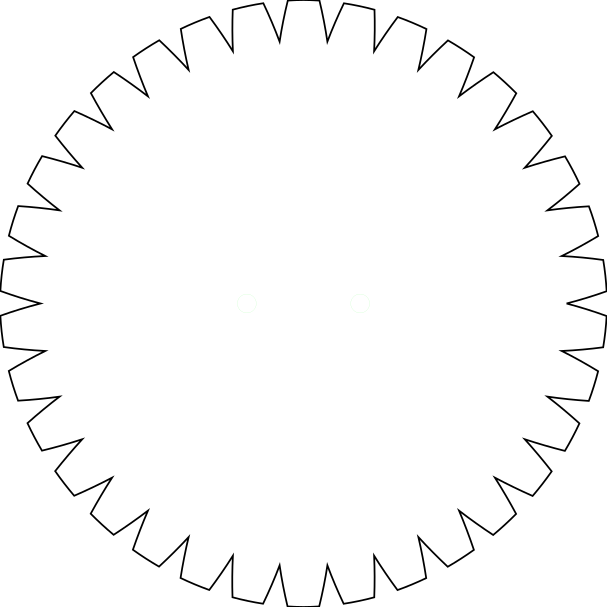
A buzz disc is a flat piece threaded on a loop of cord that passes through two holes near its centre. Wind the loop up by swinging the disc, then pull and release the ends rhythmically: the cord unwinds, spins the disc, winds up the other way, and the disc whirrs back and forth. A toothed rim turns that whirr into a buzz.
Two designs, both cut-ready, both with a pair of 5mm cord holes.
Get the files
- Everything as a ZIP — both designs.
- Repository — if you want to change the outline or the hole spacing.
- Or click either picture below to download that one cut file.
Released under CC0 1.0 — do what you like with them, no attribution needed. Built for LaserMadeMusic.
The rest of the build files — every instrument, generator and tool, indexed.
The two designs
Click either to download the cut file. The pictures are display renderings — the cut files draw a hairline on no background at all, which a browser shows almost invisibly, so these are thickened and painted onto a light ground and cropped to the part. Green, orange and cyan are darkened in the picture — at full strength they are too pale to read against a light ground. The cut file keeps the exact values. Each is at its own scale; read the sizes rather than the pictures.
 |
 |
| Toothed disc · 160 × 161mm | Plain bar · 150 × 40mm |
What the files contain
Measured out of the files themselves:
| Design | Outline | Cord holes | Spacing, centre to centre |
|---|---|---|---|
BuzzDisc1.svg | 160.5 × 160.7mm, sawtooth rim | two, 5mm | 30mm |
BuzzDisc2.svg | 150.0 × 40.0mm rectangle | two, 5mm | 25mm |
In both, the pair of holes straddles the centre and sits on the centreline — 15mm and 12.5mm either side of it respectively. That symmetry is what lets the disc wind and unwind evenly instead of wobbling.
Each file is cropped to the part itself, so the sheet is the outline — 160.5 × 160.7mm for the disc, 150 × 40mm for the bar. Output is millimetre-true — 1 user unit = 1 mm with a physical width/height — so it prints and cuts at real size.
Colour is the cut order
Colour is the cut order, and it is the same in every LaserMadeMusic repository: blue engraves, then green → orange → cyan → black. Black is always the last cut, the one that frees the part; violet means skip and is never cut. A file uses only the stages it needs. There is no engrave layer here, and only two of the four cut stages are used.
| Colour | What | Why then | |
|---|---|---|---|
| 1 | green #00ff00 | the two cord holes | while the part is still whole |
| 2 | black #000000 | the outline | frees the part, so it goes last |
Give both an explicit operation. A per-colour job silently skips any colour you leave unmapped — leave green out and you get a disc with nothing to thread.
What the two designs do differently
The toothed disc is the buzzing one. Its rim is cut into triangular teeth, and those teeth chopping the air are what turn a quiet whirr into the sound the instrument is named for. It is also the larger and heavier of the two, which means more stored energy and a longer run between pulls.
The plain bar has no teeth and a much smaller area. Expect it to be quieter and faster to spin up — closer to a whirring button than a buzzer. It is the simpler cut, and the better first one to try.
Before you cut
Cut these in 3mm Baltic birch plywood — that is what they are built in. The disc is under real tension in use and the cord holes are where it fails: a ply that delaminates gives way there first, which is why Baltic birch and its void-free core is worth the difference over a cheaper sheet.
Two or more laminations may sound better. Cut the same shape twice or three times and glue the copies face to face. A thicker disc carries more mass at the same radius, so it stores more energy per wind and runs longer between pulls — and the teeth present a deeper edge to the air. Worth trying before you decide the single-thickness version is what it sounds like. Line the cord holes up when you glue: they are what the whole thing turns on.
The cord is not in these files. A continuous loop through both holes is the usual arrangement; length and thickness are yours to settle by trying.
Handle it with care
Unlike a bullroarer, this one spins close to you — held between two hands, roughly at chest height, with your face above it. Mass, speed and shape all matter, and the lamination advice above makes the first of them worse on purpose.
Mass. The toothed disc is at most about 41g in a single 3mm thickness, 83g laminated twice and 124g three times (Baltic birch near 680 kg/m³; the teeth remove material, so treat those as upper bounds). That is a meaningful weight spinning a hand's width from your fingers.
Speed. A wound cord releases quickly, and the rim of a 160mm disc travels far faster than its centre. That rim is where all the teeth are.
Shape. The toothed rim is the whole point of the design — it is what makes the buzz — and it is a ring of points turning at speed. It does not have to be sharp to catch skin.
So: keep it clear of your face, and be aware the disc can come off the cord if a hole tears or a knot slips. Check both holes and the loop before each session, especially on a laminated disc where the glue line runs right through them. The plain bar has no teeth and far less area — it is the gentler one to learn the motion with.
Files
BuzzDisc1.svg · BuzzDisc2.svg | the two cut-ready designs |
previews/ | display renderings — not cut files |
index.md · index.html | this page; the markdown is the source |